

Harmonica.Com - An Instrument for Everyone Everyone Can Play!
The harmonica is the most "vocal" and most versatile of all the wind instruments. Many thousands of people begin to learn how to play the harmonica every year, but many people give up in frustration. Harmonica.Com is here to help you to learn to play the harmonica, to have fun playing the harmonica, so to find out how much fun the harmonica really can be, so take a look around!
Harmonica Store
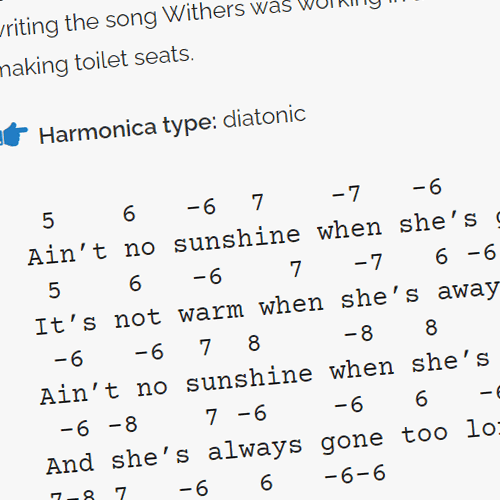
How to Play Harmonica Tabs
A large family of harmonica instruments
There is a large family of harmonica instruments - you may want to take a look at all of these to see which kind of harmonica you want to learn how to play. The main ones in the family are:
Diatonic harmonicas (also known as blues harps, mouth organs, or just plain "harmonica") Diatonic harmonicas are the best-known harmonicas in the West, including the U.S., Canada, and Europe. They are loved for their tone, their versatility and portability, and the fact that they can fit into harmonica holders so you can play other instruments with them at the same time. In recent years breakthroughs in diatonic harmonica playing technique have been made, such that they can be played chromatically (playing all the sharps and flats). This is done by a combination of bending, overblowing, and overdrawing, all playing techniques (virtually) unique to the diatonic harmonica.
There also are special-tuned diatonic harmonicas - here's a demo of the Hohner 365SBS
Here's how to get started learning to play the diatonic harmonica
Chromatic harmonicas
Chromatic harmonicas are set up so that the sharps and flats of a scale are acheived mechanically, through various combinations of button/slide-in and slide-out. Chromatic harmonicas are widely used for playing classical and jazz music, and also for pop, funk and blues. Famed musician Stevie Wonder created a wonderfully distinct style of chromatic harmonica playing.
Tremolo and Echo harmonicas (double reed instruments)
Tremolo and Echo harmonicas are the most popular harmonicas in the Orient. They have not just a single row of holes like the diatonic and chromatic harmonicas have, but instead have two rows of holes, one above the other. Octave harmonicas have the upper row of holes an octave higher than the lower holes. Tremolo harmonicas have the upper row of holes slightly detuned from the bottom row, producing a wavering, vibrato effect. The Tremolo and Echo harmonicas produce a thick and beautiful sound without the need for bending and single note techniques.
Harmonica Store
How to Play
How to take care of harmonicas
|