
Let’s say you wanna get better at harmonica, but you only have 5 minutes a day. What one harmonica exercise gives you the most bang for the buck? Look no further:
Level1Tone
All Aboard The Big Tone Train
The big problem that beginner harmonica players have is
weak tone.
It’s a big problem because shaping tone is how we
convey emotion.
Cool licks don’t matter, if the tone production sucks.
Tone will make or break a performance.
How do we develop great tone?
THE BIG TONE TRAIN.
💪🏼🚂🎶
The Big Tone Train will help you develop great tone as long as you are conscientious of these 3 vital fundamentals:
1️⃣ Deep Relaxed Mouth Position
2️⃣ Deep Diaphragmatic Breathing
3️⃣ Gentle Air Pressure
In this video, I’m playing a harmonica in the key of C so that beginners can follow along, but the best key harmonica to use for The Big Tone Train is a G harmonica.
Drop your hands, now bend them at the elbow and put them together and you’ll notice they fall quite a bit short of your mouth, raise your arms to get it to your mouth, do NOT raise your shoulders.
We’re sitting up tall, everything is relaxed: diaphragm, throat, mouth, face.
Practicing in front of a mirror can help you identify and release any tension, and tension is the enemy of mastery.
Articulate “who who huh huh” at the back of the throat like a monkey.
Starting with a blow and accenting the first blow, we’re gonna say who who on exhale, and then huh huh on inhale. I’m writing the syllables distinct from each other to help visualize exhale versus inhale, but the inside of the mouth should stay exactly the same shape on inhale and exhale.
Set a metronome to 62 BPM.
➡️ FIRST, COUNT OUT LOUD with it “1,2,3,4” over and over making sure you’re counting right in time with the click.
➡️ SECOND, say out loud “OUT, out, in, in” making that first word “OUT” louder than the other 3 words. Again make sure that you’re saying right along with the click.
➡️ THIRD, whisper it with the changes in breath direction, saying “who who” breathing out and “huh huh” breathing in, right along with the click of the metronome.
Now put the harmonica deep in your mouth and continue. Your top lip should be very deep on the top cover plate.
The diaphragm just pushes out for 2 clicks and pulls in for 2 clicks in a relaxed fashion, and the pulsating on every click is coming only from the back of the throat.
And this is how we create the breath engine. 🫁🚂🎶
It’s simple, but ain’t just for beginners. I spoke with Ross Garren who has played on records by artists Beyonce, Bon Iver, Kesha, Ben Folds, and Timothée Chalamet, and he’s also been making this exercise a priority, and he also agrees this is one of the best ways to develop great tone.
It puts the FUN into fundamentals and it’s a piece you can actually perform. You can check out 7 Days to Learning Harmonica to learn how to perform this as a song with the whistle and everything.
But in THIS lesson, we’re gonna explore how to maximize your growth on the harmonica with just 5 minutes a day. And the key that really begins to unlock it is what we’re gonna learn in Level 2… let’s GO!!!
Level2Rhythm
Play Without Breaking The Groove
Now that we’ve got our foundations to develop great harmonica tone, we can turn our attention to playing with great time, and locking in the groove.
As guitar player extraordinaire Regi Wooten says “melody makes you remember, and the harmony makes you feel, but the rhythm awakens the dead bones – it makes you move.”
Rhythm is also where musicians connect their playing in space and time.
Rhythm is the most important thing in modern music. And it’s successfully executed by first learning to internalize a beat.
❔ Question: But HOW exactly DO we learn to internalize a steady pulse?
👉 Answer: To conquer rhythm, one must first make peace with the metronome.
But before we “learn to make peace with the metronome”, I wanna explain something about the concept of the gears of the train.
It’s good to sway to the beat so that you can get your body connected. Think like a boxer, just a subtle twist.

When we PERFORM the train, we start out really slow and get faster and faster, there’s a point at which swaying is getting too fast, so we have to shift gears from one pulse per sway to 2 pulses per sway.
As we continue to increase our speed there will be another point at which it’s getting too hard for our bodies to keep up, so we readjust it from 2 pulses per sway to 4 pulses per sway, and that’s what we call 3rd gear.
We can stay in 3rd gear to infinity and beyond. (We never need to go into 4th gear.)
So I just wanted to clarify that if you’re doing the accelerating train in performance, the gears are NOT making sudden jumps in speed, but rather we are readjusting our bodies.
BUT for our purposes TODAY, I’m teaching you this magic 5 minute drill, where we find our cruising speed, play it with a metronome, and never break the groove.
We’ve already played in 1st gear, which is one articulation per click, when we were working on our tone in Level 1.
❕ Let’s move to 2nd gear now, which is 2 articulations per click.
Set a metronome at 60 BPM.
Our mantra is: ”If you can say it, you can play it!”
➡️ So first listen to the click, and count along “1,2,3,4.” But we are playing 2 pulses per click, so we’ll need to count twice as fast. 1 is with a click. 2 is in between a click. 3 is on the next click. 4 is in between clicks.
➡️ Great! Now at the same speed say “OUT out in in” making that first word much louder than the rest, still listening to the metronome.
➡️ Now say “WHO who huh huh” in the same fashion.
➡️ Now changing air direction whispering “who who” on an exhale on one click and inhaling “huh huh” on the next click.
➡️ And now put the harmonica in your mouth.
Again, the diaphragm isn’t pulsing on every articulation, it’s nice and relaxed, pushing air out on 1 click, and drawing air in on the next, and the throat is pulsing 2 times per click.
By the way, don’t hesitate to take the harmonica out of your mouth from time to time and just continue the rhythmic breathing without the harmonica for a minute. This can help us to stay relaxed as we’re working on this stuff.
Now as we move to 3rd gear today, start with the metronome at 50 BPM.
Once you are move to saying “who who huh huh” with the change in breath direction, or even when counting numbers, if the speed feels too fast to keep up, you can pull it down to 48, 45 BPM, or even all the way down to 40 BPM. But start at 50, because it’s very hard to slow down to 40 right off the bat. (If you try it, you’ll see what I mean! Counting along with 40 BPM without rushing is a JEDI skill. 😉)
❕ 3rd gear is 4 articulations per click.
Remember: If we can say it, we can play it, so DON’T SKIP THIS IMPORTANT STEP: say this out loud “1,2,3,4” you have to get in all 4 numbers before the next click, and then start over again on the next click.
➡️ Now say OUT out in in
➡️ Now WHO who huh huh
➡️ Now whispering with changes in breath direction
➡️ Now put the harmonica in your mouth
Our diaphragm is now pushing air out on the clicks and drawing air in half way between each click.
Try stopping playing the harmonica and the throat pulses, and just do the diaphragm pushing air out on the clicks and drawing air in halfway in between each click. Get used to that feeling. Nice and relaxed.
➡️ Now our throat is articulating 4 times per click.
➡️ And now put the harmonica back in your mouth and keep it going.
Repeat this as often as you feel like while working on this.
PRO TIP: With the big tone train, as we get faster and faster, we also want to focus on getting quieter and quieter. And make sure you are STRONGLY accenting the beat 1 (that first WHO).
This is the daily exercise to commit to: Find your cruising speed, put on your metronome, and develop your breath engine.
Now what do I mean by cruising speed?
Metronomes have tap buttons to help us figure out what BPM a given tempo is.
Start playing your train speed up to the fastest speed you can play without any tension, and tap along on your metronome’s tap button, and that’s around your cruising speed. If you find you can’t…
THIS IS THE DRILL:
Your daily exercise is to set a timer for 2-3 minutes,
and play along with the metronome at your cruising speed
WITHOUT breaking the groove. EVER.
Then each day you can increase your tempo by just 1 BPM. Here’s some rough tempo markers:
- 40-80 Beginner
- 80-100 Intermediate
- 100-130 Fast
- 140-150+ Jedi
But listen up: the goal is NOT to just play as FAST as possible as SOON as possible.
Work on playing with good time and good tone, keeping the dynamics low and controlled, but we are NOT going to stop the groove.
At this point you’re probably discovering one of the biggest roadblocks we all hit at some point in our journey with the harmonica, and that’s breathing.
I played for 30 years before I cracked the code, and in Level 3 I’m going to give you the secret that unlocks how to master breathing .
👉 BTW if you’re digging this lesson and you want to turbo-charge your harmonica growth you might want to consider checking out my Beginner to Boss course where I take you in bite-sized bits from total beginner to total boss. Check it out here.
And now for Level 3…
Level3Breathing
Play From a Lower Lung Range
Most wind instruments are only played by blowing air. Harmonica is very unique in that it’s played both by blowing AND drawing.
And it’s one of the reasons that it’s so good for your health, and has been scientifically proven to improve lung function for people with ailments like COPD.
As I mentioned abovce, when I practice the Big Tone Train I actually use a G harmonica.
The lower keys require more breath to activate the reeds, so they give you a better workout which is why people who are using harmonica to medically improve their lung function should use low keys.
If you were looking for a good excuse to buy another harmonica, now you’ve got a good excuse to go buy a key of G, and that’s not just coming from me, it’s also what our sensei Joe Filisko recommends.
And speaking of Joe it was his critique that gave me my breathing breakthrough a couple of years ago.
I was working on his harmonica study song in the style of the seminal 20th century harmonica virtuoso Sonny Terry and sent him a video of me playing it for his critique and he said:
I see distress in your body which tells me that you are not getting down into your lower range of breathing enough.
“Play from deeper in my lungs?” I thought to myself, perplexed. “What the heck does that mean?”
I mean WAS breathing from my diaphragm like I showed you in level 1 of this vid? How can I breathe from any lower than that?
After a couple of perplexed days scratching my head, I finally got it and it’s been a total gamechanger. Let’s break it down:
Because we all naturally want to stay alive, depriving our bodies of oxygen will send us into a feeling of panic.
But here’s the thing – that feeling which we call “the asphyxiation reflex” can happen from running out of air OR from running out of room in our lungs when they overfill.
So the 1st step is to ask yourself “am I running out of air or am I overfilling”, and this step can be trickier than you think!
I get people all the time asking me to help them with their breathing, telling me that they’re running out of air, and I always ask, “Are you sure you’re running out of air?” and 8 times out of 10, they’ll come back and tell me that they realized they’re actually overfilling.
This graphic is incredibly helpful for visualising this. I stole this from a PDF entitled ‘Filisko’s Breathing Guide’. (BTW I highly recommend downloading ALL of Joe’s free resources and reading them over again every so often. Priceless stuff. You can download them here.)
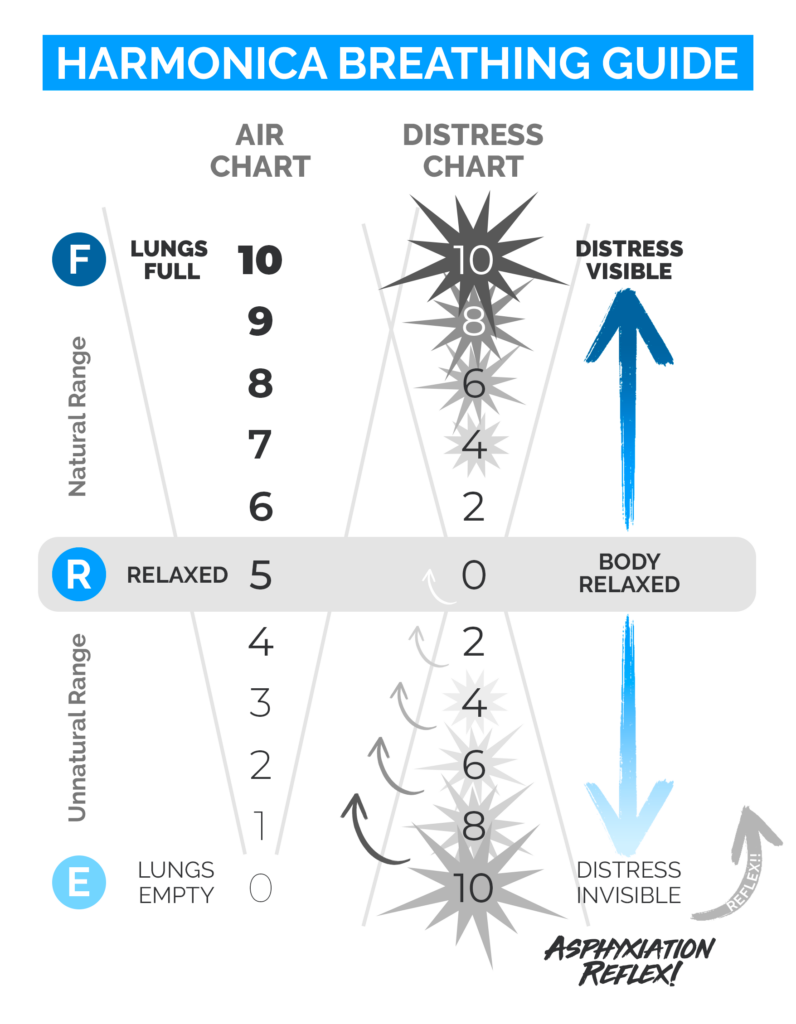
In the middle here R is for relaxed. Halfway between empty and full.
↗️ From R to full represents the upper range of your breathing.
↘️ From R to empty is the lower range of your breathing.
When the lungs start to empty our body will naturally fight to get more air in. That’s why it says “REFLEX” with the arrow at the bottom right corner. That’s a reflex that will happen without us even noticing. This can sabotage us as harmonica players by causing us to unconsciously allow air in thru our nose while playing draw notes, or by causing us to unconsciously gasp in some air thru our mouths right before we play, causing our lungs to overinflate.
❗ Overfilling is the more common of the two scenarios. And it triggers a more visible reflex.
This is what Joe saw when he gave me his critique. He wasn’t telling me to breathe from lower in my lungs, he was telling me to work from a lower RANGE within my lungs.
In other words he was saying, “don’t allow your lungs to get over-inflated, try to keep them more deflated.”
We need to consciously train ourselves to learn to play from the lower range of our lungs.
And we have to learn to use the nose as a valve to help equalize our lung pressure as needed.
Playing the train quietly is one of the best ways to practice this.
I can play just through my mouth, through my mouth and nose at the same time, or just through my nose.
This is the secret to keeping your lungs equalized.
The great teacher David Kachalon calls this “phasing”. By the way, if you want to work privately with a teacher on this exercise, you won’t find a better candidate than David K. I’ve taken many lessons with him, and so has the LA harmonica player Ross Garren whom I interviewed in the video, and we both agree he is an absolute genius in this area. You can email him at davidkachalon@gmail.com.
We’ve covered 3 of the benefits of working on the Big Tone Train, but becoming aware of level 4 gives you the skills to stop sounding like a beginner, and play with the kind of emotion and beauty that will truly impact your listeners.
Level4Tremolo & Vibrato
Using Throat Articulations
Tremolo and Vibrato are the musical terms to describe the wavering that can add expressiveness to a note:
👉 Tremolo is a fluctuation in the volume of a note.
👉 Vibrato is the fluctuation in pitch of a note.
There’s different ways to accomplish this on the harmonica, but the richest is to use the throat.
So practicing the big tone train is building up the muscles we need to be able to execute these vital techniques. We can add tremolo to chords, double stops, and splits, as well as to single notes.
It may seem like a minor detail but it’s amazing how much expressiveness it can add to our harmonica playing!
Blow notes 1-6 don’t bend, but we can add tremolo to them using a gentle coughing technique – the same muscle that we’re using to play our train.
Draw notes 1-6 do bend and once you learn how to bend, you can put your mouth into a position that’s close to the position you would use to bend, you can get a little bit of fluctuation in pitch as well as volume.
So here the throat articulations that we’ve developed thru the Big Tone Train are pulling our mouth into the bent position and we’re getting that little pitch drop.
I spoke with a vocal teacher who’s worked with tons of big marquee celebrity singers and he told me vibrato generally hovers around 5 or 6 pulses per second on average. Some are a little faster, some slower, but that speed will sound natural to our ears.
After he told me this I thought, “let me work on that”.
So I put on a metronome at 60 BPM (which equals 1 Beat Per Second) and started using this technique to get 2, 3, 4, and eventually I could get it up to 5 pulses per second, but I hit a ceiling there.
But 6 pulses per click at 60 BPM is exactly the same as tempo as 4 pulses per click at 90 BPM.
So once we get our train up to 90 BPM we are working out our muscles at around the same speed as the vibrato of the world’s great singers.
Once you’ve practiced the Big Tone Train to build up your throat tremolo muscles if you’d like some one songs to practice it on, try Taps in 2nd position:
-1 -1 2
-1 -2 -3
-1 -2 -3 -1 -2 -3 -1 -2 -3
-2 -3 -4
-3 -2 -1
-1 -1 -2
The other classic song for working on and showcasing tremolo and vibrato is Easy Blues by Big Walter Horton, which is song #28 in my video The First 50 Songs You Should Learn on Harmonica – click here to go check it out here.

Comments
Got something to say? Post a comment below.